The Onboarding Drop-Off Problem in DeFi - and the Capital It Leaves Behind

Decentralized finance does not suffer from a lack of interest. It suffers from a failure to convert interest into on-chain activity.
Over the past few years, crypto adoption has accelerated globally. Around 700 million people worldwide now own cryptocurrency, up from just over 580 million in 2023.
Yet despite this growth, DeFi protocols continue to struggle with user acquisition efficiency.
Where users drop off
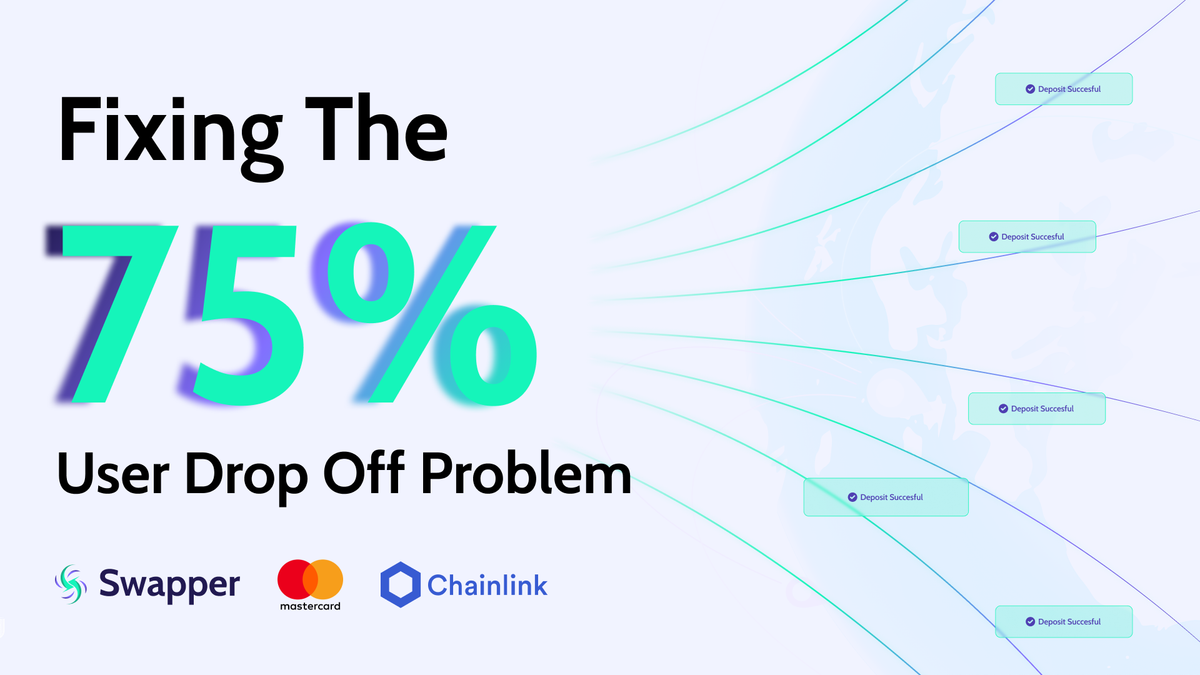
More than 60 percent of users drop off the onboarding process before completing their first crypto transaction.
The most common failure points are:
- KYC verification
- payment checkout
- first fiat-to-crypto conversion
- wallet setup and transaction confirmations
This means that the majority of users who show intent to enter crypto never reach on-chain.
The hidden cost of complexity in DeFi
Traditional DeFi onboarding typically requires users to:
- create and secure a wallet with a seed phrase
- acquire a gas token
- select the correct network
- bridge assets across chains
- execute a first swap / transfer
For experienced users, these steps are routine. For new users, they are overwhelming and stressful. Each step increases the risk of drop-off.
A measurable funnel leak that directly impacts protocol growth and marketing efficiency.
Estimating the lost capital
To understand the scale of the problem, we can model the potential capital impact.
What the numbers show:
- Tens of millions of users attempt to enter the crypto or DeFi space every year
- 60-75 percent abandon onboarding before completion
- With 80 million attempts last year, that means over 48 million users were lost at the point of entry.
If improved onboarding infrastructure recovered just 20 percent of these lost users, that would mean:
- over 9 million additional users onboarding successfully
the median gross amount transferred to crypto accounts is approximately $620
that translates into: Nearly $6 billion of new capital entering the market annually.
This capital already exists. It simply fails to reach on-chain markets.
Why this matters now
The limiting factor for crypto adoption is no longer access to payment rails.
Global card networks already serve billions of users. For example, Swapper’s partner - Mastercard - alone supports more than 3.5 billion cards worldwide.What has been missing is a way to connect those rails directly to decentralized execution environments without forcing users through centralized exchanges and multi-step workflows.
Infrastructure as the solution
Swapper Finance represents a shift from user education to user abstraction.
Swapper eliminates the technical friction of DeFi, replacing it with a simple one-step gateway. Through direct execution, users transition from Fiat / CEX / Web3 Wallet payment to active DeFi usage in a single embedded flow.
The collaboration between Chainlink, Mastercard, and Swapper Finance demonstrates how traditional finance and DeFi can be connected without compromising decentralization or compliance.
Conclusion
DeFi does not need more complexity, and it does not need more features.
It needs to stop losing users at the exact moment they are ready to participate.
By addressing the onboarding drop-off problem, the industry can unlock hundreds of millions of dollars in capital that already wants to enter the market but never makes it on-chain.
The next phase of DeFi growth will not be driven by new protocols alone, but by infrastructure that finally allows users to enter without friction.