From CEX Dependency to Direct On-Chain Access

How DeFi Is Moving Beyond Its Original Entry Gate
To access the decentralized finance world, users first had to go through centralized exchanges. The CEX became the default gateway into DeFi - not by design, but by necessity. That necessity shaped the entire onboarding experience.
The CEX as the mandatory first step
The typical path into DeFi required creating an account on a centralized exchange, waiting for verification, depositing funds, converting fiat into USDT / USDC, then converting again into the selected cryptocurrency. After that, the user had to withdraw the asset to a Web3 wallet, select the correct network, and ensure the transfer was executed properly. Only after completing all of these steps could the user finally enter the DeFi ecosystem.
But what if the desired token was not listed on the exchange?
Despite the already long journey, additional steps were required. Users had to use a bridge to transfer their assets to another blockchain or swap tokens again on the destination chain.
Of course, this flow worked. But it was long, fragmented, and fragile.
Every additional step introduced more time, more fees, more complexity, and more potential for costly mistakes or hacks.
In effect, decentralized finance depended on centralized exchanges to function at the entry level.
Why this dependency existed
Early DeFi lacked three critical components: regulated fiat infrastructure, reliable on-chain routing, and secure, compliant execution layers.
Centralized exchanges filled that gap. They handled fiat deposits, compliance, and custody, and users then manually moved funds into DeFi environments.
However, this was never the ideal solution to the core problem - direct access to the DeFi ecosystem.
As the ecosystem matured, the inefficiencies of this model became more visible.
The cost of the extended journey
When users are required to deposit fiat on a CEX, buy an intermediary asset, withdraw to a wallet, manually select networks, bridge across chains, and manage gas tokens, the journey from intent to action becomes unnecessarily long.
This extended path creates friction at the exact moment of highest motivation - when someone has already decided to participate.
The result is predictable: drop-off increases, conversion decreases, security risks multiply, and user confidence declines.
CEX dependency was never a defining feature of DeFi. It was a structural workaround.
The shift toward direct on-chain access
Infrastructure is now evolving beyond that workaround.
Direct on-chain access removes the need for centralized exchange intermediation at the onboarding stage.Swapper enables this shift by embedding execution directly into the protocol layer, eliminating the need for users to exit to external platforms.
Instead of Fiat → CEX → Wallet → DeFi, the flow becomes Fiat → Immediate protocol interaction through Swapper’s infrastructure.
Centralized exchanges still play their role, but they should not function as a mandatory first step.
What changes with direct access
When onboarding is embedded directly into protocol infrastructure, users do not leave the platform to acquire crypto or execute a specific on-chain action. Everything happens within a single application. The user no longer needs to move between multiple services.
With Swapper, network selection and routing are handled automatically.
Funds are delivered directly to the execution environment.
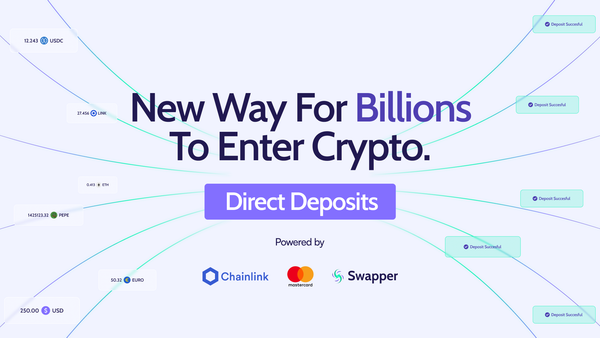
Through direct deposits, users can transfer funds directly into a protocol using the asset of their choice, without manually managing bridges or gas tokens.
This reduces friction, operational risk, and dependency on external intermediaries. It also shortens the distance between user intent and on-chain action.
Infrastructure replaces dependency
Direct on-chain onboarding is enabled by the combination of regulated payment rails, compliant processing partners, on-chain validation, and smart contract execution.With infrastructure backed by Mastercard & validated and secured through Chainlink, the entry layer of DeFi no longer requires a centralized exchange as a middleman.The ecosystem is transitioning from exchange dependency to infrastructure-native access, where entry is built directly into the protocol layer.
A structural evolution
This transition represents a structural shift in how users access decentralized systems.
Early DeFi depended on centralized exchanges because it had to.
Next-generation DeFi, powered by Swapper - integrates fiat access directly into its infrastructure, removing unnecessary intermediaries while ensuring full security and simplicity for the end user.
The future of onboarding is not about teaching users how to navigate complexity. It is about designing systems that no longer require it.