Breaking the Onboarding Bariers That Prevent DeFi From Reaching Billions .


Access to DeFi remained gated by a complex onboarding process that filtered out most users before they ever reached their first on-chain transaction.
The old DeFi onboarding model - where users were lost
Until now, entering DeFi required users to navigate a fragmented and high-risk journey. For a new user, the process typically looked like this:
Create a self-custodial wallet: Download a wallet extension or app → Generate and securely store a seed phrase → Understand the responsibility of key management
Acquire crypto through a centralized exchange: Register an account → Complete KYC → Wait for verification → Deposit fiat via bank transfer or card
Withdraw funds to the wallet: Manually copy wallet address → Select the correct blockchain network → Pay withdrawal fees → Risk irreversible mistakes
Prepare for DeFi usage: Acquire gas tokens → Bridge assets if the target protocol is on another chain → Confirm multiple transactions
Execute the first on-chain action: Interact with unfamiliar interfaces → Approve smart contracts → Manage slippage, gas fees, and network settings
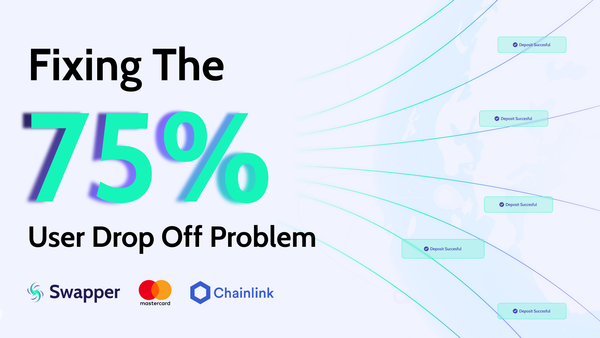
Each step introduced friction and security risk.For non-technical users, this process was overwhelming. For protocols, it resulted in massive user drop-off at the point of highest intent.
Complexity as a security risk
The old onboarding model did not just reduce conversion, but It also increased security risks.
Users were forced to:
- handle private keys before understanding the ecosystem
- copy addresses manually
- interact with multiple third-party platforms
In other words, complexity itself became an attack surface.
The new onboarding - abstraction instead of forced education
Swapper introduces a fundamentally different approach.
Instead of educating users to navigate DeFi complexity, it abstracts that complexity away. The goal is not to change how DeFi works on-chain, but to radically simplify how users enter.
How Swapper replaces the old flow
Fiat to crypto conversion
Before
Users relied on centralized exchanges or external on-ramps, often leaving the protocol environment entirely.
With Swapper
Users purchase crypto directly on-chain using a payment card, without leaving the platform. Fiat is converted and executed as an on-chain transaction in a single flow.
All is enabled through infrastructure backed by Mastercard and validated on-chain via Chainlink.
Transfers and network selection
Before
Users had to withdraw funds from exchanges, manually copy wallet addresses, select the correct blockchain network, acquire gas tokens, and worry about making mistakes during transfers.
With Swapper
Through direct deposits, users can transfer funds directly from their wallet into the protocol. They simply choose the asset they want to use, while the infrastructure handles network selection, routing, and execution in the background.
First on-chain interaction
Before
The first DeFi interaction required approvals, gas management, and understanding of complex interfaces.
With Swapper
Users arrive on-chain already activated. Assets are immediately usable for trading, staking, or protocol-specific actions.
Why fewer steps means higher security
Swapper reduces the number of failure points where users can make mistakes or be exploited.
Security is built into the infrastructure through regulated payment processing, cryptographic validation, and on-chain execution.
The result is a flow that is simpler for users and safer by design.
Conclusion
The evolution of DeFi onboarding is not about sacrificing decentralization for convenience.It is about removing unnecessary friction that never needed to exist in the first place.
By replacing fragmented, complex workflows with a secure, direct on-chain experience, Swapper removes the final barrier between users and decentralized finance.
The future of DeFi growth will not be driven by teaching users to survive complexity, but by building infrastructure that removes it.
Read more about “The Onboarding Drop-Off Problem in DeFi - and the Capital It Leaves Behind” in our previous article